NEET PG PYQs: Do They Repeat? (Free 2018-2025 Guide)
NEET PG PYQs: Do They Repeat? (Free 2018-2025 Guide)
Preparing for NEET PG is often described as trying to drink from a firehose. With 19 subjects to cover and over 230,000 candidates competing for limited PG seats, optimizing your study strategy is crucial.
Many aspirants spend thousands of rupees on printed books or search endlessly for shady PDF downloads of previous year questions (PYQs).
This guide breaks down the science of PYQ repetition, why static PDF resources fail, and how to practice NEET PG PYQs from 2018 to 2025 for free.
How many PYQs are repeated in NEET PG?
Direct word-for-word question repetition in NEET PG is extremely rare, typically accounting for only 2 to 3 questions per exam. However, concept repetition is incredibly high, with approximately 30% to 40% of the exam questions targeting the same high-yield topics, clinical signs, and management guidelines1.
When commercial platforms advertise a "90%+ strike rate" or claim hundreds of repeated questions, they are referring to topic overlap rather than identical question stems. Since the MBBS curriculum is finite, the National Board of Examinations (NBE) naturally revisits the same core clinical scenarios, but they frame them with new clinical vignettes, fresh lab values, or different diagnostic images.
To succeed, you must shift your focus from memorizing specific answers to mastering the underlying clinical concepts. If a question about a specific disease appeared in a previous paper, you are highly likely to see that same disease again, but with a more challenging twist.
Why are NEET PG PDF downloads and PYQ books inefficient?
Static PDF dumps and printed PYQ books are highly inefficient because they promote passive reading, contain uncorrected errors, and lack the interactive memory triggers required for active recall.
Preparing for a computer-based test (CBT) like NEET PG by reading a static PDF is like preparing for a marathon by watching someone else run. Here is why traditional offline PYQ resources fall short:
- Illusion of Competence: Reading a question and immediately looking at the bolded answer key below it creates a false sense of familiarity. You feel like you know it, but your brain has not done the cognitive work of retrieving the answer from memory2.
- Lack of Spaced Retrieval: Standard books and PDFs present questions in a fixed order. Once you solve them, they sit idle. Without a system to reschedule questions you got wrong, you will likely forget them within a few weeks3.
- Outdated Guidelines & Lab Values: Clinical medicine is constantly evolving. Static PDFs from 2018 to 2025 often contain outdated drug choices or obsolete staging systems. Furthermore, practicing clinical case vignettes requires analyzing dynamic values (like arterial blood gases: pO2 and pCO2) in context, which static printouts cannot simulate.
| Feature | Static PYQ PDFs & Books | OpenMedQ Interactive Practice |
|---|---|---|
| Cognitive Engagement | Passive reading (low retention) | Active testing (forces memory retrieval) |
| Review Scheduling | Chronological order (no spacing) | FSRS v6 algorithm (optimized intervals) |
| Clinical Guidelines | Outdated (static printed facts) | Real-time updates (aligned with latest NBE) |
| Environment Fit | Bulky or hard to read on phone | Local-first IndexedDB (works offline in wards) |
Where can you practice NEET PG PYQs 2018-2025 for free?
You can practice subject-wise and chapter-wise NEET PG previous year questions for free on OpenMedQ, which includes detailed clinical explanations and full offline access.
Instead of hunting for virus-prone PDF links or carrying heavy books, OpenMedQ offers a modern, completely free alternative. When you load a subject pack on the platform, the entire question set is saved locally in your browser's IndexedDB.
This local-first architecture allows you to practice actively on your phone or laptop even in hospital wards or hostel basements with zero internet connectivity. The explanations are unlocked, updated to reflect current guidelines, and completely free of paywalls or advertisements.
What is the best strategy to prepare for NEET PG using PYQs?
The most effective strategy to prepare for NEET PG using PYQs is to solve questions actively, review the entire topic surrounding your mistakes, and use spaced repetition scheduling to lock those concepts into long-term memory.
Rather than just counting how many questions you solved today, apply this systematic approach:
- Active Testing: Force yourself to choose an answer before reading the explanation. This active retrieval strengthens the neural pathways associated with that memory2.
- Topic Deep-Dive: When you get a question wrong, do not just read the correct option. Study the entire clinical presentation, diagnostic tests, and first-line treatments for that disease.
- FSRS Scheduling: OpenMedQ integrates the state-of-the-art science of spaced repetition using the FSRS v6 algorithm4. When you struggle with a question, marking it for early review ensures it returns right before your brain is about to forget it.
- Cross-Exam Integration: Do not limit yourself to NEET PG papers. Include INI-CET and FMGE previous year questions in your practice, as they share highly overlapping clinical concepts and cognitive difficulty levels.
By integrating PYQ practice with a structured NEET PG 2026 preparation strategy, you can focus your limited study hours on the subjects that yield the highest returns.
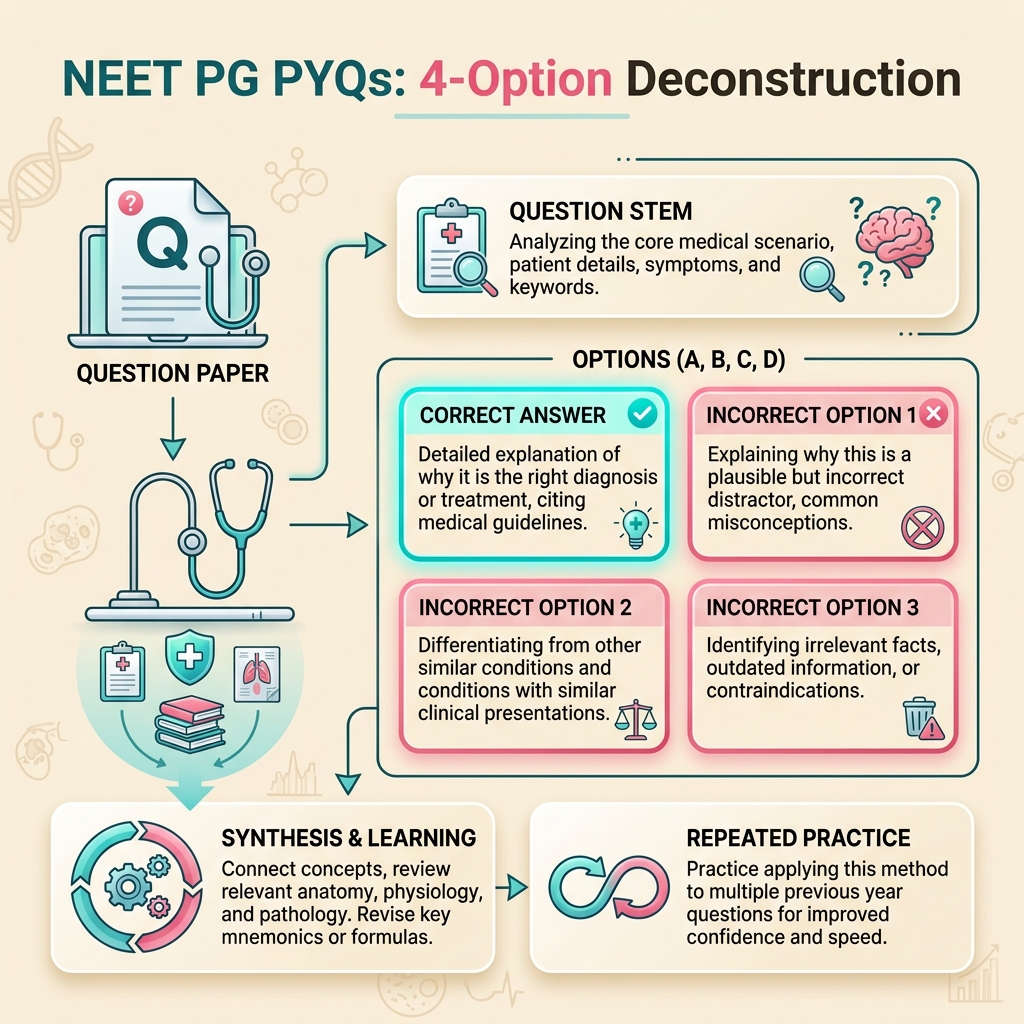
How to analyze a NEET PG PYQ (The Four-Option Deconstruction)
Analyzing previous year questions is not about checking if you got the answer right; it is about deconstructing why the examiner chose each option. NBE examiners frequently convert a wrong option from a previous year's question into the correct answer for a future exam.
To extract maximum value from every past question, use the 4-Option Deconstruction Method:
- Step 1: Commit to an Answer: Try to solve the question actively without looking at the explanations.
- Step 2: Understand the Right Option: Understand why the correct answer is the gold standard diagnostic test or drug of choice.
- Step 3: Analyze the 3 Incorrect Options: Research the other three options. Write down the specific clinical scenario or disease where each of those incorrect options would have been the correct answer.
- Step 4: Tag and Schedule: Mark the question based on your memory retrieval difficulty. OpenMedQ's FSRS scheduler will automatically recalculate the next review interval to ensure you revisit the concept right before it slips from your memory.
By deconstructing the wrong options, you turn a single past question into four learning points.
Top High-Yield PYQ Concepts (The "Always Tested" List)
While exact questions rarely repeat, certain high-yield topics are tested in almost every exam. When practicing PYQs from 2018 to 2025, prioritize these recurring concepts:
- Pre-Clinical Subjects:
- Anatomy: Cranial nerves (specifically III, IV, VI palsy and VII course), nerve injuries of the upper and lower limbs, and dermatomes.
- Physiology: Cardiac cycle curves, renal tubular transport mechanisms, and respiratory volume loops.
- Biochemistry: Inborn errors of metabolism (like glycogen storage diseases), enzyme kinetics (Vmax and Km changes), and the urea cycle.
- Para-Clinical Subjects:
- Pathology: Amyloidosis stains, cellular adaptations, glomerulonephritis patterns, and tumor suppressor genes.
- Pharmacology: G-protein coupled receptor mechanisms, anti-arrhythmic drug classes, and monoclonal antibody suffixes.
- Microbiology: Bacterial culture media, viral replication cycles, and hypersensitivity reactions.
- Clinical Subjects:
- Medicine: ECG interpretations (like myocardial infarction or heart blocks), endocrine guidelines (diabetes mellitus management), and types of shock.
- Surgery: Burns resuscitation (Parkland formula), trauma primary survey protocols, and staging of breast carcinoma.
- Obstetrics & Gynecology: Contraceptive choices, ectopic pregnancy management, and pre-eclampsia/eclampsia protocols.
How many years of PYQs should you solve for NEET PG?
You should focus exclusively on the last 5 years of PYQs (2020–2025). Going back further than 2018 is highly counterproductive because the National Board of Examinations (NBE) shifted the exam pattern from simple factual recall questions to long, integrated clinical vignettes.
For subjects that remain relatively static, like Anatomy or Physiology, you can look back up to 7 or 8 years if time permits. However, for dynamic subjects that have frequent guideline updates (such as Social & Preventive Medicine, Obstetrics & Gynecology, and Pharmacology), prioritize the most recent 3 years to avoid memorizing outdated clinical protocols.
Remember that quality of analysis beats quantity: deconstructing 5 years of papers thoroughly is far more effective than clicking through 10 years of questions passively.
How does negative marking affect your PYQ strategy?
Since NEET PG has a strict negative marking penalty (+4 for correct, -1 for incorrect), practicing PYQs helps you train intelligent clinical guessing. Statistically, if you can eliminate even a single incorrect option using your clinical knowledge, you should always attempt the question, as the probability yield is mathematically positive.
Solving PYQs actively teaches you how to identify "distractor" options and eliminate wrong choices under pressure. Instead of leaving questions blank due to fear of negative marking, you should use your practice sessions to build the confidence needed to make calculated guesses.
When is the NEET PG 2026 exam?
The NEET PG 2026 exam is scheduled to be conducted on August 30, 2026 by the National Board of Examinations (NBE)5. This leaves candidates with limited time to consolidate their 19-subject preparation and run through key clinical concepts.
To put the competition in perspective, during the NEET PG 2025 exam (which took place on August 3, 2025), a total of 230,114 candidates actually appeared out of 242,493 registered students6. With nearly a quarter-million doctors competing for postgraduate seats, ranking in the top 1st percentile requires active testing and revision under timed conditions rather than passive reading of PDF dumps.
You need to train your test-taking stamina and clinical reasoning. Start practicing with high-yield previous year concepts early, prioritize active recall, and let modern algorithms manage your revision schedule.
About the Author
This guide was written by a 3rd-year medical student. All preparation methodologies, clinical values, and FSRS algorithm parameters are verified against standard textbooks and recent National Board of Examinations (NBE) blueprints.
References
- PrepLadder & ReflexPrep. (2025). NEET PG Paper Analysis: Concept Overlap vs. Question Repetition Rates (2020-2025).
- Karpicke, J. D., & Blunt, J. R. (2011). Retrieval Practice Produces More Learning than Elaborative Studying with Concept Mapping. Science, 331(6018), 772-775. https://doi.org/10.1126/science.1199327
- Ebbinghaus, H. (1885). Memory: A Contribution to Experimental Psychology. Teachers College, Columbia University.
- Ye, J., et al. (2024). Free Spaced Repetition Scheduler (FSRS) Algorithm Optimization for Academic Learning. GitHub Repository.
- National Board of Examinations in Medical Sciences (NBEMS). (2026). Official NBEMS Examination Calendar & Schedule for NEET PG 2026.
- Press Trust of India / Ministry of Health. (2025). NEET PG 2025 Exam Turnout: 2.3 Lakh Candidates Appear Across 1,052 Centers.
Ready to start? Get instant, free access to over 190,000 verified clinical MCQs and previous year concepts on the OpenMedQ dashboard. No subscriptions, no ads, just pure learning.