INI-CET Exam Guide: Dates, Registration, Results & Strategy
INI-CET Exam Guide: Dates, Registration, Results & Strategy
Preparing for postgraduate medical admission in India is one of the most demanding journeys a medical graduate can undertake. While NEET PG is the largest exam in terms of candidate volume, the Institute of National Importance Combined Entrance Test (INI-CET) represents the absolute pinnacle of clinical difficulty and prestige.
Securing a residency seat at institutions like AIIMS New Delhi, PGIMER, or JIPMER requires a highly specialized approach. This comprehensive guide covers the essential dates, the AIIMS PAAR registration process, scorecard downloads, candidate statistics, and evidence-based strategies to crack the INI-CET exam.
What is the INI-CET exam?
The Institute of National Importance Combined Entrance Test (INI-CET) is a national-level postgraduate medical entrance examination conducted by the All India Institute of Medical Sciences (AIIMS), New Delhi, for admission to MD, MS, MCh (6 years), DM (6 years), and MDS courses1.
The INI-CET serves as the single gateway for entry into India’s most prestigious medical institutions, known collectively as the Institutes of National Importance (INIs). A single score determines your rank for admission into:
- AIIMS: AIIMS New Delhi and all other campuses (including AIIMS Bhopal, Bhubaneswar, Jodhpur, Nagpur, Patna, Raipur, Rishikesh, and others)2.
- PGIMER: Post Graduate Institute of Medical Education and Research, Chandigarh3.
- JIPMER: Jawaharlal Institute of Postgraduate Medical Education and Research, Puducherry.
- NIMHANS: National Institute of Mental Health and Neurosciences, Bengaluru.
- SCTIMST: Sree Chitra Tirunal Institute for Medical Sciences and Technology, Trivandrum.
How many times a year is the INI-CET exam conducted?
The INI-CET exam is conducted two times a year by AIIMS, New Delhi, divided into two distinct academic sessions: the January Session and the July Session1.
The January session exam is typically conducted in November of the preceding year (for example, the INI-CET Nov 2025 exam is for the January 2026 session). The July session exam is conducted in May of the same year (for example, the INI-CET May 2026 exam is for the July 2026 academic session). This bi-annual cycle gives aspirants two opportunities each year to secure their dream specialty without waiting a full year between attempts.
When is the INI-CET exam conducted? (2025–2026 Dates)
The INI-CET exam dates are officially announced by AIIMS New Delhi in their annual academic calendar, with separate timelines for registration, admit cards, and results.
The table below outlines the timeline for recent and upcoming INI-CET exam cycles:
| Exam Cycle / Session | Registration Start | Admit Card Release | Exam Date | Result Date |
|---|---|---|---|---|
| INI-CET May 2025 (July 2025 Session) | March 2025 | May 5, 2025 | May 11, 2025 | May 17, 2025 |
| INI-CET Nov 2025 (Jan 2026 Session) | September 2025 | November 3, 2025 | November 9, 20254 | November 15, 20254 |
| INI-CET May 2026 (July 2026 Session) | March 2026 | May 11, 2026 | May 16, 20265 | May 23, 20265 |
| INI-CET Nov 2026 (Jan 2027 Session) | Sept 2026 (Expected) | Nov 2026 (Expected) | Mid-Nov 2026 (Expected) | Late-Nov 2026 (Expected) |
Note: In case of unexpected administrative challenges, announcements regarding any INI-CET postponement are published exclusively on the official portal (aiimsexams.ac.in). Candidates are strongly advised to ignore unverified social media rumors.
How to apply for the INI-CET exam? (AIIMS PAAR Registration Flow)
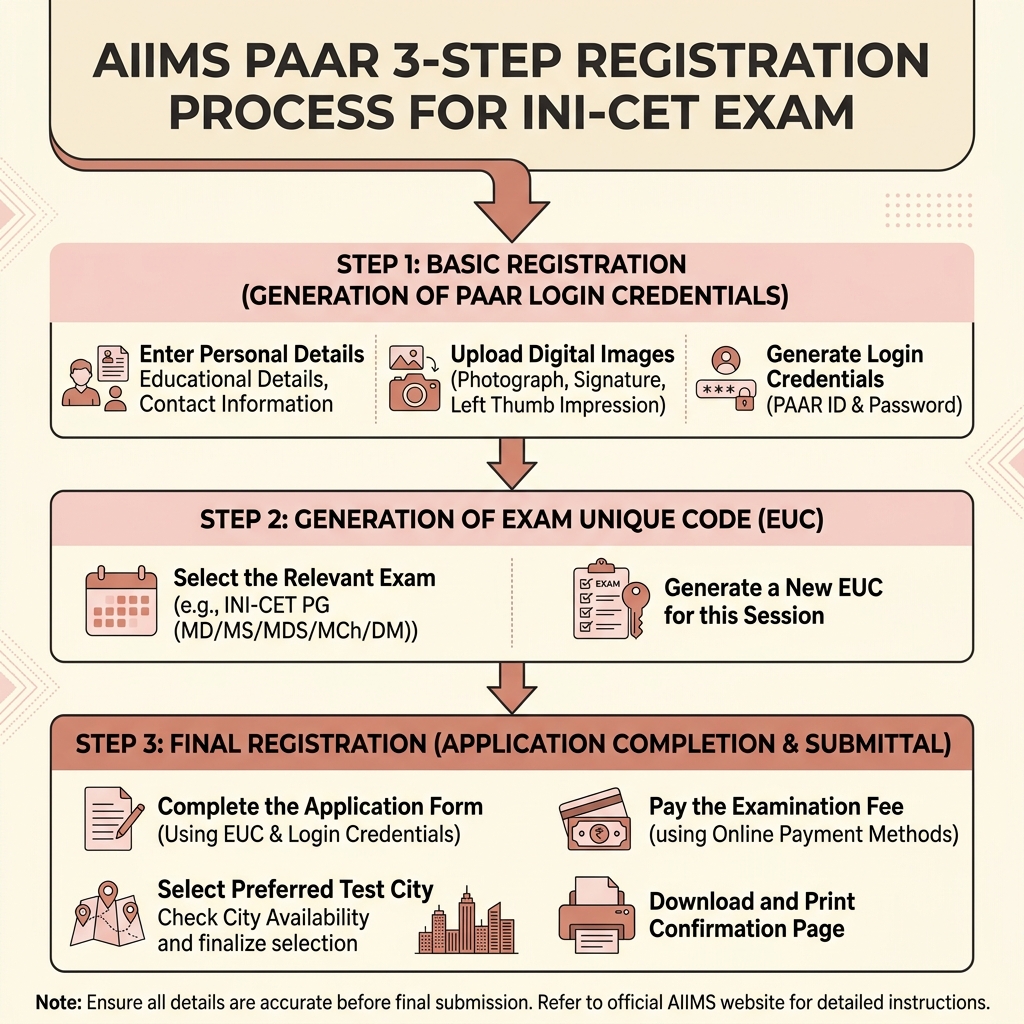
To apply for the INI-CET exam, candidates must complete the AIIMS Postgraduate Prospective Applicants All-in-One Registration (PAAR) process on the official portal6.
The PAAR system is designed to simplify applications by separating basic details from session-specific details. It is divided into three mandatory steps:
- Step 1: Basic Registration: You enter your primary personal information, contact details, and upload digital images (photograph, signature, and left thumb impression). Once accepted, your Basic Registration remains valid for future sessions, meaning you do not have to fill it out again if you retake the exam.
- Step 2: Generation of Exam Unique Code (EUC): During the active application window for a specific session, you must generate an Exam Unique Code (EUC). This code links your basic profile to the current active exam session (e.g., January 2026 or July 2026 session).
- Step 3: Final Registration: Log in using your PAAR credentials and the generated EUC. Complete the final form by submitting your academic qualifications, paying the examination fee, choosing your preferred test city, and downloading the confirmation page.
AIIMS PAAR Photo & Image Upload Specifications
Adhering strictly to AIIMS PAAR image guidelines is the most critical factor to prevent application rejection. If your images do not meet the precise digital standards, your registration will be marked "Rejected" during the basic validation window.
Ensure your uploads meet the following checklist:
- Color Photograph:
- Must be taken against a white background (colored or patterned backgrounds are rejected).
- Dimensions must be 3.5 cm x 4.5 cm (JPEG/JPG format, file size 20 KB to 100 KB).
- Your face must occupy at least 70-80% of the image, looking directly at the camera with both ears visible. No spectacles with tinted lenses or caps.
- Signature:
- Write your signature clearly on a white sheet of paper using a black ballpoint pen (blue ink or gel pens are often rejected due to poor scanner contrast).
- Scan and crop the signature area to 6.0 cm x 3.0 cm (file size 10 KB to 50 KB, JPG/JPEG format).
- Left Thumb Impression:
- Press your left thumb onto a blue or black ink pad, then stamp it onto clean white paper.
- Scan and crop to 4.0 cm x 3.0 cm (file size 10 KB to 50 KB, JPG/JPEG format). Ensure the ridge patterns are clearly visible and not smudged.
How many students appeared for the INI-CET 2025?
For the INI-CET November 2025 exam (January 2026 session), approximately 58,000 candidates appeared for the test out of more than 90,000 initial registrations7.
For the INI-CET May 2026 exam (July 2026 session), the number of candidates who appeared rose to approximately 75,0008. Out of the candidates who appeared, a total of 32,374 qualified in the November 2025 session9, while 51,563 qualified in the May 2026 session8.
These statistics highlight that while qualifying is relatively common (since the qualifying cutoff is set at the 50th percentile for general candidates), securing a clinical MD/MS seat in a top-tier government institution requires ranking in the top 1% (usually within the top 500 to 1,000 ranks nationwide).
How to download the INI-CET admit card and scorecard?
You can download your INI-CET admit card and scorecard by logging into the official AIIMS examinations portal using your PAAR registration ID, password, and Exam Unique Code (EUC)6.
Follow these step-by-step instructions for each document:
How to download the INI-CET admit card:
- Visit the official website at aiimsexams.ac.in.
- Click on the "Academic Courses" tab and select "MD/MS/MCh (6 years)/DM (6 years)".
- Use the INI-CET login panel to enter your Registration ID, EUC, Password, and Captcha code.
- Locate the "Admit Card" link on the left-hand navigation panel.
- Review the details (ensure your exam center, spelling, and roll number are correct) and click "Print". Note: AIIMS typically releases the admit card 7 to 10 days before the scheduled exam date.
How to download the INI-CET scorecard:
- Navigate to the AIIMS exams homepage after the official results are declared.
- Log in through the PG portal using your PAAR credentials.
- Click on the "Scorecard" tab.
- Download and print the PDF. Your scorecard will display your raw score, overall percentile, and All India Rank (AIR)6. Note: The scorecard is usually released within 5 to 7 days of the result notification and is essential during the counseling process.
How does the INI-CET counselling and seat allocation process work?
Once AIIMS New Delhi releases the percentiles and scorecards, the seat allocation and counselling process is conducted online via a series of choice-filling rounds.
The admission flow consists of the following phases:
- Mock Round (Round 0): Candidates submit their initial preferences of colleges and specialties. AIIMS runs a simulated allotment to show candidates what seat they would get based on current preferences. No seats are finalized in this round; it is purely to guide your final choice-filling strategy.
- Round 1 & Round 2: Final seat allocations. If allocated a seat, you must choose one of two options:
- Option 1: Accept the allocated seat, deposit your original documents, and opt out of further upgrading rounds.
- Option 2: Accept the allocated seat but state your intention to participate in the next round for upgrading. (If you get upgraded, the previous seat is auto-cancelled).
- Open Round (Spot Counselling): Conducted for any vacant seats left after Round 2. Any qualified candidate (who has not blocked a seat in previous rounds) can participate, often leading to spot allocations for clinical seats at lower ranks.
Caution: Blocking a seat and failing to join carries strict penalties, including the forfeiture of your security deposit (typically Rs. 3,00,000) and disqualification from subsequent rounds.
What is the subject-wise weightage for the INI-CET exam?
AIIMS New Delhi does not publish an official subject-wise blueprint for the INI-CET. However, analysis of recent exam sessions (such as May 2026 and November 2025) reveals a consistent pattern in subject-wise question distribution.
The 200 questions of the INI-CET are heavily weighted toward clinical integrated case studies, making the clinical and paraclinical subjects the core rank-definers:
| Subject Category | Subject Name | Estimated MCQs | Priority Level |
|---|---|---|---|
| High-Yield Clinical | Medicine & Allied (Pediatrics, Dermatology, Psychiatry) | 40–44 | High (Rank Maker) |
| High-Yield Clinical | Surgery & Allied (Orthopedics, Anesthesia, Radiology) | 32–36 | High (Rank Maker) |
| High-Yield Clinical | Obstetrics & Gynecology | 24–28 | High (Rank Maker) |
| Para-Clinical Core | Pathology | 20–24 | High |
| Para-Clinical Core | Pharmacology | 16–18 | High |
| Para-Clinical Core | Microbiology | 14–16 | Medium |
| Pre-Clinical Core | Anatomy | 12–14 | Medium |
| Pre-Clinical Core | Physiology | 10–12 | Medium |
| Pre-Clinical Core | Biochemistry | 8–10 | Low |
| Specialist Para-Clinical | Social & Preventive Medicine (SPM / PSM) | 10–12 | Medium |
| Clinical Specialties | Ophthalmology | 6–8 | Low |
| Clinical Specialties | ENT (Otorhinolaryngology) | 6–8 | Low |
| Para-Clinical Core | Forensic Medicine & Toxicology (FMT) | 4–6 | Low |
How is the INI-CET score calculated?
The INI-CET score is calculated based on a paper containing 200 multiple-choice questions (MCQs) with a total duration of 180 minutes10.
The marking scheme applies a strict penalty for incorrect choices to discourage blind guessing:
- Correct Response: +1 mark is awarded10.
- Incorrect Response: A penalty of -1/3 mark (-0.33) is applied10.
- Unattempted Questions: 0 marks (no penalty).
| Parameter | MD / MS / DM / MCh Stream | MDS (Dental) Stream |
|---|---|---|
| Total Questions | 200 | 200 |
| Correct Option | +1 mark | +1 mark |
| Incorrect Option | -1/3 mark (-0.33) | -1/5 mark (-0.20)11 |
| Unattempted | 0 marks | 0 marks |
Percentile vs. Percentage Scoring
AIIMS converts raw scores into percentiles. The percentile indicates the percentage of candidates who scored equal to or below that particular candidate. If two candidates obtain the same percentile, the tie is broken by giving a higher rank to the candidate with fewer negative marks10.
How to crack the INI-CET exam? (Preparation Strategy)
Cracking the INI-CET requires you to shift from passive, factual memorization to mastering complex, multi-system clinical reasoning and active recall.
Unlike NEET PG, which tests a mix of direct recalls and clinical facts, the INI-CET consists almost entirely of conceptual, single-correct, multi-correct, and match-the-following clinical case vignettes. Apply these evidence-based strategies to optimize your study time:
- Master the "Institutes" Pattern: AIIMS examiners love clinical integration. Instead of studying Anatomy or Pharmacology in isolation, integrate them. For instance, when studying the Anatomy of the cavernous sinus, simultaneously study Pharmacology (anticoagulants) and Microbiology (Staphylococcus aureus causing cavernous sinus thrombosis).
- Calibrated Guessing: Since the negative marking penalty is -1/3 (whereas NEET PG is -1/4 under its +4/-1 scheme), the mathematical yield of guessing is positive if you can eliminate even one option. Use NEET PG PYQs practice sessions to train your elimination skills.
- Spaced Repetition (FSRS): Trying to revise 19 subjects right before the exam is impossible without a structured retrieval system. By using the science of spaced repetition, OpenMedQ's FSRS v6 scheduler dynamically adjusts your review intervals. If you struggle with a difficult pathology slide or pharmacology drug mechanism, the algorithm forces you to review it right before you are about to forget it.
- Practice Under Timed Conditions: The 180-minute constraint for 200 lengthy clinical stems causes severe fatigue. Dedicate your final 2 months to solving mock modules on the OpenMedQ practice suite to build the cognitive stamina needed on exam day.
By aligning your preparation with a structured NEET PG 2026 preparation strategy, you can naturally master the overlap between these two major post-graduate exams.
Anatomy of an INI-CET Question: Integrated Clinical Vignette
To understand how INI-CET questions differ from standard recalls, let us deconstruct a typical high-yield clinical case vignette. Instead of asking a direct factual question about a drug or sign, the AIIMS paper tests multiple disciplines (Pathology, Microbiology, and Medicine) in a single question.
The Clinical Vignette
A 32-year-old male presenting with high-grade fever, severe headache, and neck stiffness for 3 days is brought to the emergency department. On examination, he has a positive Kernig's sign. CSF analysis shows a pressure of 280 mm H2O, white blood cell count of 1,200/µL (90% neutrophils), protein level of 180 mg/dL, and glucose level of 15 mg/dL. Gram stain reveals Gram-negative, kidney-bean-shaped diplococci.
Deconstructing the Options:
- The Diagnosis: The CSF profile (high neutrophils, high protein, extremely low glucose) indicates Acute Bacterial Meningitis. The Gram stain (Gram-negative kidney-bean diplococci) specifically identifies Neisseria meningitidis12.
- Option A: Ceftriaxone (Empiric Choice): Ceftriaxone is a third-generation cephalosporin that is the drug of choice due to its excellent CSF penetration. This represents the Pharmacology clinical correlation.
- Option B: Latex Agglutination (Rapid Diagnostics): This tests capsular antigens in CSF and represents the Microbiology rapid diagnostic link.
- Option C: Waterhouse-Friderichsen Syndrome (Pathological Complication): In severe cases, meningococcemia leads to bilateral adrenal hemorrhage and shock. This represents the Pathology morphological link.
When practicing this PYQ on OpenMedQ, you should not just click Ceftriaxone and move on. You must active-recall:
- What would the CSF profile look like for Viral Meningitis? (Normal glucose, lymphocytic predominance).
- What is the mechanism of action of Ceftriaxone? (Inhibits bacterial cell wall synthesis by binding to penicillin-binding proteins).
- What is the prophylaxis drug of choice for close contacts? (Rifampicin or Ciprofloxacin).
By deconstructing the vignette this way, you reinforce four distinct clinical facts in a single practice session.
About the Author
This guide was written by a 3rd-year medical student. All registration steps, marking schemes, and candidate statistics are cross-referenced with official bulletins from AIIMS Exams and standard medical education blueprints.
References
- All India Institute of Medical Sciences (AIIMS) Exams. (2026). Prospectus & Official Information Bulletin for INI-CET PG MD/MS/MCh/DM Admissions.
- AIIMS New Delhi. (2025). Participating Institutes and Seat Matrix Updates for Postgraduate Courses.
- Post Graduate Institute of Medical Education and Research (PGIMER). (2025). Academic Guidelines and Admission Rules for MD/MS Admission.
- AIIMS Exams Portal. (2025). Official Result Notification for INI-CET January 2026 Session (Exam Held Nov 9, 2025).
- AIIMS Exams Portal. (2026). Official Schedule and Key Dates for INI-CET July 2026 Session (Exam Held May 16, 2026).
- AIIMS PG PAAR Portal. (2026). Step-by-Step Prospective Applicants All-in-One Registration (PAAR) Process Manual.
- Careers360. (2025). INI-CET November 2025 Exam Analysis: Candidate Attendance, Difficulty Levels, and Results.
- Careers360. (2026). INI-CET May 2026 Results Announced: 51,563 Candidates Qualify for July Session.
- AIIMS exams. (2025). List of Qualified Candidates in INI-CET January 2026 Session (Held on 09-11-2025).
- AIIMS Exams Section. (2026). Scheme of Examination and Tie-Breaking Methodologies for INI-CET PG Exams.
- NEET PG AI / Zynerd. (2026). AIIMS MDS Stream Marking Scheme and Negative Marks Structure.
- Tille, P. (2025). Bailey & Scott's Diagnostic Microbiology (16th ed.). Elsevier.
Ready to start? Get instant, free access to over 190,000 verified clinical MCQs and previous year concepts on the OpenMedQ dashboard. No subscriptions, no ads, just pure learning.