What is the FMGE Exam? Guide to Results, Attempts & NExT
What is the FMGE Exam? Guide to Results, Attempts & NExT
Preparing for medical licensing can feel like navigating a complex maze. For Indian students returning from foreign universities, the FMGE (Foreign Medical Graduates Examination) is the most critical milestone standing between their medical degree and clinical practice in India.
With pass percentages historically hovering in the low double digits, having a clear understanding of the exam, its timelines, and an effective preparation strategy is essential.
This comprehensive guide covers everything you need to know about the FMGE, including attempt rules, result timelines (2025-2026), pass percentages by country, and the future transition to the NExT exam.
What is the FMGE exam? (FMGE Full Form)
The FMGE, whose full form is the Foreign Medical Graduates Examination, is a mandatory screening test conducted by the National Board of Examinations in Medical Sciences (NBEMS) to license Indian citizens who obtained their MBBS degrees abroad to register and practice medicine in India1.
Under the National Medical Commission (NMC) regulations, the FMGE exam is compulsory for all foreign medical graduates who wish to register with the Medical Council of India (MCI) or State Medical Councils. The only exceptions are students who completed their undergraduate medical studies in the United States, United Kingdom, Canada, Australia, or New Zealand, as these countries qualify for direct registration.
For all other foreign countries, passing this screening test is a legal requirement before graduates can begin their mandatory internship in India.
FMGE Exam Pattern & Structure
The FMGE is a computer-based test (CBT) consisting of a single paper with 300 multiple-choice questions (MCQs). The exam is structured as follows:
- Two Parts: The exam is split into two sessions (Part A and Part B) of 150 questions each, conducted on the same day.
- Duration: Candidates are allotted 150 minutes (2.5 hours) for each session.
- No Negative Marking: Every correct response earns 1 mark, and no marks are deducted for incorrect answers.
- Qualifying Score: You must score a minimum of 150 out of 300 marks (50%) to qualify.
Is the FMGE exam tough? (Is it tougher than NEET?)
Yes, the FMGE exam is exceptionally tough, with historical pass percentages ranging between 10% and 30%. While NEET PG is a ranking exam used for post-graduate seat allotment, the FMGE is a qualifying exam where candidates must score a minimum of 150 out of 300 marks to pass2.
Many students wonder if the FMGE is tougher than NEET. Because NEET PG is competitive, getting a top-tier clinical seat is extremely difficult. However, simply qualifying in NEET PG is relatively easy compared to FMGE, where nearly three-quarters of the candidates fail to pass in any given session.
The low qualifying rate is driven by three main factors:
- Long Clinical Case Vignettes: The NBE has shifted the FMGE towards clinical, scenario-based questions that test practical diagnostic decision-making rather than simple rote recall.
- Clinical Exposure Gaps: Foreign universities often have patient demographics, disease profiles, and clinical teaching structures that differ significantly from the Indian hospital environment.
- The 19-Subject Syllabus: The exam tests candidates across the entire MBBS curriculum, requiring massive knowledge retention.
How many attempts are allowed for the FMGE exam?
There is currently no limit on the number of attempts a candidate can take to pass the FMGE screening test. Candidates who do not qualify in a given session are permitted to register and appear for the exam in subsequent sessions as many times as needed3.
The exam is conducted twice a year, typically in June and December. While there is no official cap on the number of attempts, candidates should aim to pass early. The time spent repeating attempts creates a significant delay in starting internships, and the emotional burden can lead to burnout.
Structuring your study schedule around active recall and spaced repetition is the best way to ensure you clear the hurdle in your 1st or 2nd attempt.
Is the FMGE exam replaced by NExT?
The National Exit Test (NExT) is legally designed to replace both the FMGE and NEET PG as a single unified licensing and postgraduate entrance examination; however, the National Medical Commission (NMC) has deferred its implementation indefinitely4.
As of 2026, the FMGE remains the active mandatory screening pathway for foreign medical graduates. While the transition to NExT will eventually happen to standardize medical licensing across domestic and foreign graduates, students preparing for the upcoming sessions should focus entirely on the current FMGE exam pattern conducted by NBEMS.
When are the FMGE exam and result dates (2025-2026)?
The FMGE is conducted twice a year, and results are typically published by NBEMS within 20 to 30 days of the exam date. For the June 2026 session, the FMGE exam date was June 28, 2026, with the FMGE result 2026 scheduled to be released by July 28, 20265.
Understanding the historical and tentative timelines helps candidates plan their preparation cycles:
- FMGE 2025 Timelines: The FMGE 2025 exam date for the summer session was July 6, 2025, and the FMGE result July 2025 was declared on July 29, 2025. The winter session was held on January 17, 2026.
- FMGE Result January 2026: The results for the January 17, 2026 session were declared by NBEMS on February 6, 2026. Out of 24,000+ candidates who appeared, the pass percentage was reported at 23.9%6.
- FMGE Exam Date 2026: The summer session took place on June 28, 2026, and the winter session is tentatively scheduled for mid-December 2026 or early January 2027.
How to check FMGE results:
- Visit the official NBEMS results portals at
natboard.edu.inornbe.edu.in. - Click on the FMGE link under the examinations tab.
- Select the results PDF for the relevant session (e.g., June 2026).
- Download the PDF and search for your roll number to view your status (Pass/Fail) and score.
- Qualified candidates will receive notification regarding the schedule for receiving their FMGE Pass Certificate in person.
Which country has the highest FMGE pass percentage?
Foreign medical graduates from neighboring countries like Bangladesh and Nepal historically achieve the highest FMGE pass percentages, often exceeding 35% to 45%, while graduates from China, Russia, and Ukraine see average qualifying rates of 10% to 20%7.
Candidates from Bangladesh and Nepal perform exceptionally well due to several clinical factors:
- Patient Profile Similarity: The disease profiles, tropical infections, and patient demographics in South Asia are highly similar, giving these students relevant clinical exposure.
- Clinical Postings: Medical colleges in Bangladesh and Nepal place a strong emphasis on hands-on clinical rotations and bedside teaching.
- Textbook Overlap: These universities share identical standard Indian textbooks (like Bailey & Love, Robbins, Harrison's) and exam formats.
How to prepare for the FMGE exam using active recall?
To clear the FMGE screening test, you must focus on active testing instead of passive re-reading. Given the low pass rates, reading notes repeatedly creates a false sense of familiarity while failing to build test-taking stamina.
- Focus on High-Yield Concepts: Prioritize subjects that carry the highest marks weightage. Rather than spending equal time on all subjects, structure your prep around the official NBEMS marks blueprint:
| Subject Category | Subject Name | Approximate Marks |
|---|---|---|
| Clinical Sciences (200 Marks) | Medicine & Allied (including Psychiatry, Dermatology) | 33 Marks |
| Surgery & Allied (including Orthopedics, Anesthesia, Radiotherapy) | 32 Marks | |
| Obstetrics & Gynecology (OBG) | 30 Marks | |
| Social & Preventive Medicine (PSM) | 30 Marks | |
| Pediatrics | 15 Marks | |
| Ophthalmology | 15 Marks | |
| Otorhinolaryngology (ENT) | 15 Marks | |
| Pre- & Para-Clinical (100 Marks) | Anatomy | 17 Marks |
| Physiology | 17 Marks | |
| Biochemistry | 17 Marks | |
| Pathology | 13 Marks | |
| Microbiology | 13 Marks | |
| Pharmacology | 13 Marks | |
| Forensic Medicine | 10 Marks |
- Practice Active Testing: Solve at least 50 to 100 MCQs daily on OpenMedQ. By testing yourself before reading the explanation, you force your brain to retrieve knowledge, which is clinically proven to double memory retention8.
- FSRS Spaced Repetition: Don't let your study reviews pile up. OpenMedQ's FSRS v6 algorithm automatically reschedules questions you get wrong based on your personal difficulty level, ensuring you review them right before your brain is about to forget9.
- Deconstruct Past Papers: Use a structured NEET PG PYQs guide to learn the NBE question-framing style. Master not only the correct options but also the three incorrect options to cover all bases.
FMGE vs NEET PG vs NExT Comparison
| Feature | FMGE Screening Test | NEET PG Entrance Exam | NExT (Unified Licensing) |
|---|---|---|---|
| Purpose | Indian medical licensing | PG seat allocation | Unified licensing & PG seat allocation |
| Eligibility | Foreign medical graduates | Indian & qualified foreign MBBS | All MBBS students in India & abroad |
| Target Score | Qualifying (Minimum 150/300) | Ranking (Relative percentile) | Multi-part (Pass/Fail + Rank score) |
| Frequency | Twice a year (June & Dec) | Once a year (August) | Proposed twice a year |
| Attempts | No limit on attempts | No limit on attempts | Attempts limits may apply under NMC rules |
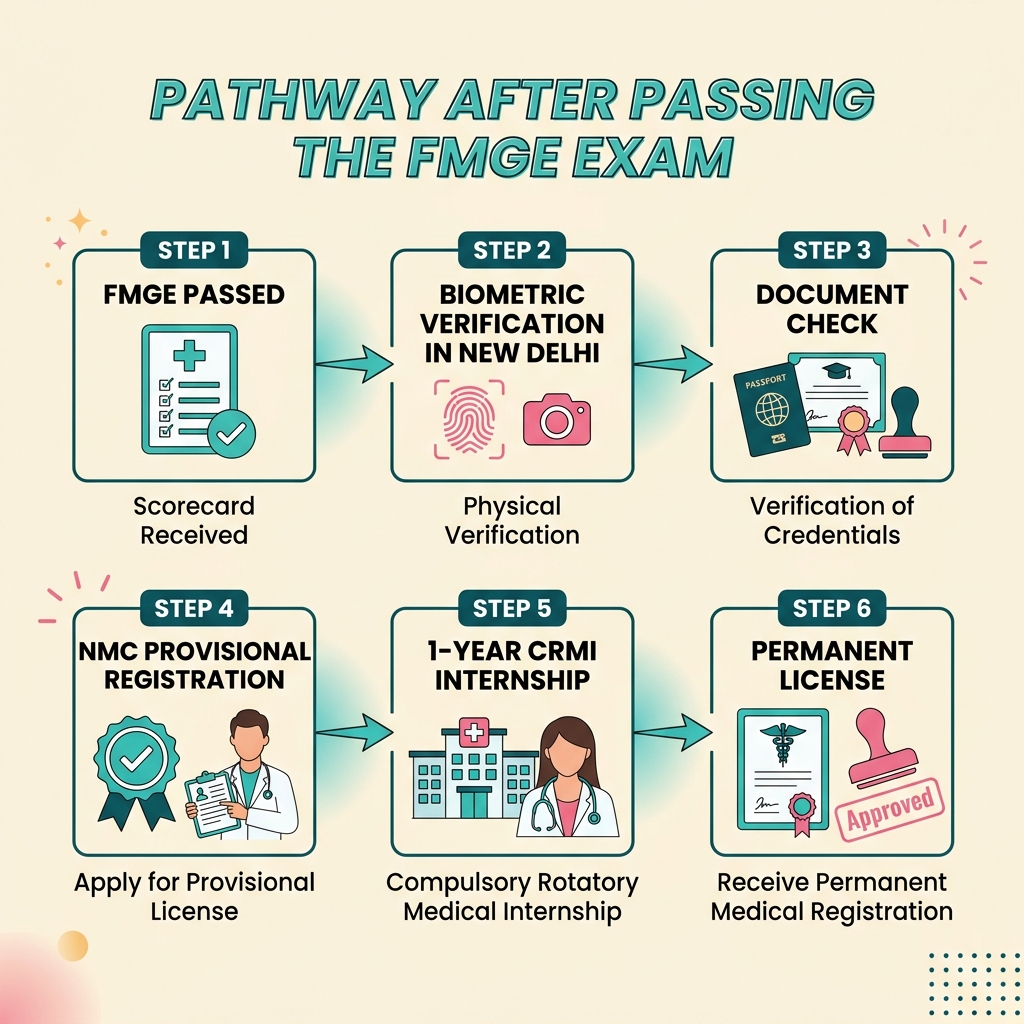
What happens after you pass the FMGE exam? (The Verification Checklist)
Qualifying in the FMGE is only the first step. To legally practice medicine in India, you must complete the mandatory NBEMS in-person credential verification to receive your physical Pass Certificate.
Here is the exact step-by-step checklist of what happens after you pass:
- Biometric & Face Verification: NBEMS schedules offline verification sessions at their New Delhi office. You must attend this session in person; no representatives or family members are allowed.
- Original Document Submission: You must present the original physical copies of the following documents:
- MBBS Degree / Primary Medical Qualification Certificate (duly apostilled or attested by the Indian Embassy in the graduating country).
- Eligibility Certificate issued by the NMC (MCI).
- Valid Passport and Student Visa.
- Class 10th and 12th Mark Sheets.
- Issuance of FMGE Pass Certificate: Once cleared, NBEMS issues your physical Pass Certificate. You must keep this document extremely secure, as duplicate copies are rarely issued.
- NMC Provisional Registration: Submit your FMGE Pass Certificate to the National Medical Commission (NMC) or your respective State Medical Council to obtain a provisional registration number.
- Compulsory Internship (CRMI): Join an approved medical hospital/college to complete your 1-year Compulsory Rotatory Medical Internship (CRMI).
Once your CRMI is successfully completed, you can apply for your permanent medical registration and begin practicing medicine independently in India.
What are the alternatives if you cannot pass the FMGE?
If you face repeated attempts and choose to look at alternative pathways, several international licensing exams allow foreign medical graduates to practice in other countries:
- USMLE (United States): The United States Medical Licensing Examination is the pathway to residency and practice in the US. It requires passing Step 1 (pass/fail) and Step 2 CK (scored).
- PLAB / UKMLA (United Kingdom): The Professional and Linguistic Assessments Board test (being transitioned to the UK Medical Licensing Assessment) is the registration pathway for the UK.
- AMC (Australia): The Australian Medical Council examinations qualify you to seek medical registration and practice in Australia.
While these exams are highly structured, passing them opens global opportunities if qualifying in India remains a challenge.
About the Author
This guide was written by a 3rd-year medical student. All information regarding NBEMS timelines, attempt rules, NExT updates, and active recall study strategies is verified against recent official NBEMS notifications and cognitive psychology studies.
References
- National Board of Examinations in Medical Sciences (NBEMS). (2026). Information Bulletin for Foreign Medical Graduates Examination (FMGE) June 2026.
- National Medical Commission (NMC). (2025). Screening Test Regulations for Foreign Medical Graduates.
- Medical Council of India (MCI) Archive. (2018). Clarification on Attempt Limits for FMGE Screening Test.
- National Medical Commission (NMC). (2025). Public Notice: Deferment of National Exit Test (NExT) Implementation.
- NBEMS. (2026). Official NBEMS Examination Calendar & Schedule for 2026 Sessions.
- Press Trust of India. (2026). NBEMS Declares FMGE January 2026 Session Results: 23.9% Pass Percentage Reported.
- Ministry of Health & Family Welfare. (2024). Performance Analysis of Foreign Medical Graduates: Country-wise Pass Percentage Trends (2020-2024).
- Karpicke, J. D., & Blunt, J. R. (2011). Retrieval Practice Produces More Learning than Elaborative Studying with Concept Mapping. Science, 331(6018), 772-775. https://doi.org/10.1126/science.1199327
- Ye, J., et al. (2024). Free Spaced Repetition Scheduler (FSRS) Algorithm Optimization for Academic Learning. GitHub Repository.
Ready to pass your FMGE? Get instant, free access to over 190,000 verified clinical MCQs and previous year concepts on the OpenMedQ dashboard. Practice offline in hospital wards, track your progress with spaced repetition, and qualify in your very next attempt.